
3D SDFs
A 3D signed-distance function maps a point in space to a single
f32: the shortest distance from that point to the surface of a solid.
The sign tells you which side you are on — negative inside the volume,
positive outside, zero exactly on the surface. With a sphere-tracer that
steps along each ray by the current distance value, that one number is
enough to render lit, intersected, smoothly-blended geometry without a
mesh.
The registry separates primitives (sphere, box, torus, …) that
return a distance, from operators (op_*) that combine or warp
distances. Booleans (op_union, op_subtract, op_intersect, plus
their smooth variants) take two distances and return one. Domain
operators (op_bend, op_twist, op_mirror, op_repeat,
op_elongate) transform the input point before you sample a primitive.
op_round and op_onion reshape any distance into a rounded or hollow
version.
Every entry below is a single pure WGSL function in the registry. Pull
one (or several, for compositions) into a Shader::new call, then call
them from a fragment stage that runs a small sphere-trace and shades the
hit:
let main = r#"fn scene(p: vec3<f32>) -> f32 { return sphere(p, 0.7); }@fragment fn fs_main(in: VertexOutput) -> @location(0) vec4<f32> { // ... sphere-trace `scene` and Lambert-shade the hit ...}"#;let shader = Shader::new(&["sdf/sphere", main])?;Each preview below renders the SDF on a 256×256 fragment with a fixed
camera at (0, 0, -2.5) looking down +z, sphere-traces the scene, and
applies a single Lambert light. Tune the parameters to your own scene;
the registry shape is just the function.
Axis-aligned box centered at the origin with half-extents b.
fn box(p: vec3<f32>, b: vec3<f32>) -> f32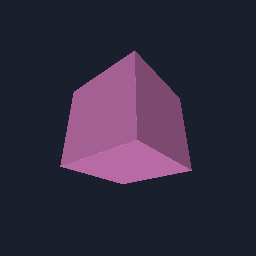
capsule
Section titled “capsule”Capsule (pill) between endpoints a and b with radius r.
fn capsule(p: vec3<f32>, a: vec3<f32>, b: vec3<f32>, r: f32) -> f32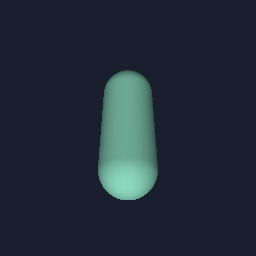
Infinite cone with half-angle encoded as c = vec2(sin, cos). Apex at
the origin, axis along +y. Combine with a plane or box to bound it.
fn cone(p: vec3<f32>, c: vec2<f32>) -> f32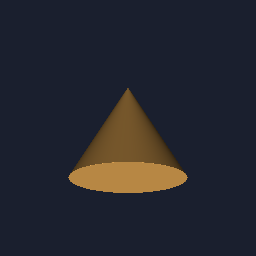
cylinder
Section titled “cylinder”Capped vertical cylinder with half-height h and radius r.
fn cylinder(p: vec3<f32>, h: f32, r: f32) -> f32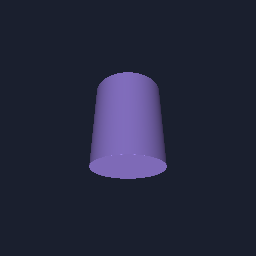
ellipsoid
Section titled “ellipsoid”Approximate signed distance to an ellipsoid with axis radii r. The
gradient is not unit length, but it is close enough for sphere-tracing.
fn ellipsoid(p: vec3<f32>, r: vec3<f32>) -> f32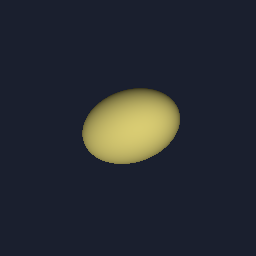
hexagonal_prism
Section titled “hexagonal_prism”Hexagonal prism with h.x = circumradius and h.y = half-height.
fn hexagonal_prism(p: vec3<f32>, h: vec2<f32>) -> f32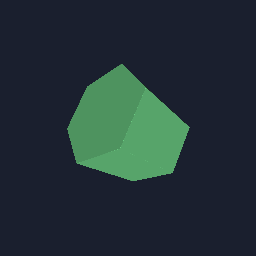
octahedron
Section titled “octahedron”Regular octahedron with half-diagonal s. Exact SDF.
fn octahedron(p: vec3<f32>, s: f32) -> f32
op_bend
Section titled “op_bend”Domain operator: bends space around the Z axis with bend rate k.
Returns the transformed point — pass it to a primitive. The preview
applies it to a long rounded box.
fn op_bend(p: vec3<f32>, k: f32) -> vec3<f32>
op_elongate
Section titled “op_elongate”Domain operator: stretches an SDF along axes by h (per-axis distance
to extend). Returns a displaced point. The preview elongates a sphere
along x.
fn op_elongate(p: vec3<f32>, h: vec3<f32>) -> vec3<f32>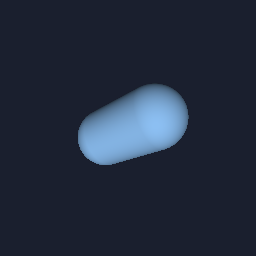
op_intersect
Section titled “op_intersect”Boolean intersection of two distance values: max(a, b). The preview
intersects a sphere and a box.
fn op_intersect(a: f32, b: f32) -> f32
op_mirror
Section titled “op_mirror”Domain operator: reflects the negative half-space onto the positive
half along the unit axis a. The preview mirrors an offset sphere.
fn op_mirror(p: vec3<f32>, a: vec3<f32>) -> vec3<f32>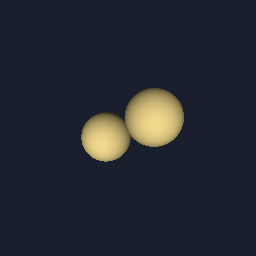
op_onion
Section titled “op_onion”Hollows any signed distance into a thin shell of thickness t:
abs(d) - t. The preview applies it to a sphere and slices it open with
a box subtraction so you can see the shell.
fn op_onion(d: f32, t: f32) -> f32
op_repeat
Section titled “op_repeat”Domain operator: tiles the input point on an infinite grid with cell
size c. Returns a displaced point. The preview tiles a small sphere.
fn op_repeat(p: vec3<f32>, c: vec3<f32>) -> vec3<f32>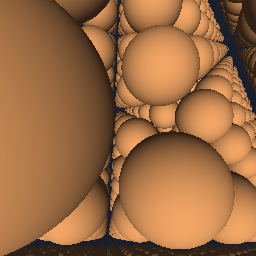
op_round
Section titled “op_round”Uniformly inflates or rounds any SDF by r: d - r. The preview
applies it to an octahedron.
fn op_round(d: f32, r: f32) -> f32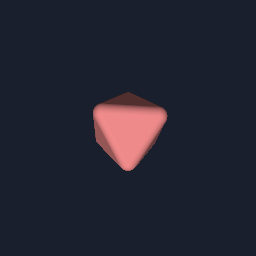
op_smooth_intersect
Section titled “op_smooth_intersect”Smooth intersection of two distances with blend radius k. The preview
intersects two offset spheres.
fn op_smooth_intersect(a: f32, b: f32, k: f32) -> f32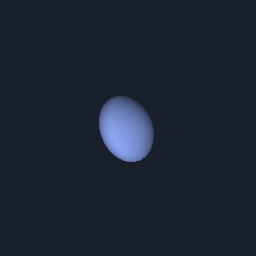
op_smooth_subtract
Section titled “op_smooth_subtract”Smooth subtraction a − b with blend radius k. The preview subtracts
a sphere from a box.
fn op_smooth_subtract(a: f32, b: f32, k: f32) -> f32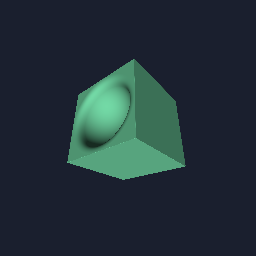
op_smooth_union
Section titled “op_smooth_union”Quadratic-polynomial smooth union with blend radius k. The preview
fuses two offset spheres.
fn op_smooth_union(a: f32, b: f32, k: f32) -> f32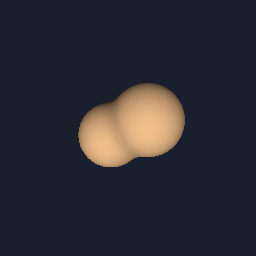
op_subtract
Section titled “op_subtract”Boolean subtraction a − b: max(a, -b). The preview cuts a sphere
out of a box.
fn op_subtract(a: f32, b: f32) -> f32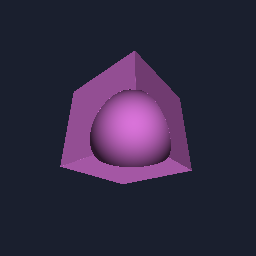
op_twist
Section titled “op_twist”Domain operator: twists space around the Y axis with twist rate k.
Returns the transformed point. The preview applies it to a long box.
fn op_twist(p: vec3<f32>, k: f32) -> vec3<f32>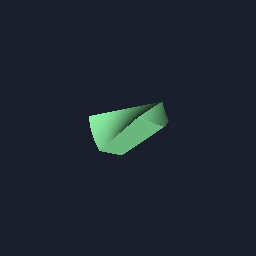
op_union
Section titled “op_union”Boolean union of two distance values: min(a, b). The preview unites a
sphere and an offset box.
fn op_union(a: f32, b: f32) -> f32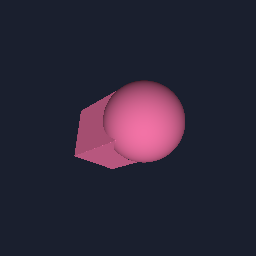
Signed distance to a plane with normal n (normalized inside) and
offset h: dot(p, normalize(n)) + h. The preview intersects a tilted
plane with a bounding sphere so the trace terminates.
fn plane(p: vec3<f32>, n: vec3<f32>, h: f32) -> f32
rounded_box
Section titled “rounded_box”Box with half-extents b and rounded corners of radius r (subtracted
from the box).
fn rounded_box(p: vec3<f32>, b: vec3<f32>, r: f32) -> f32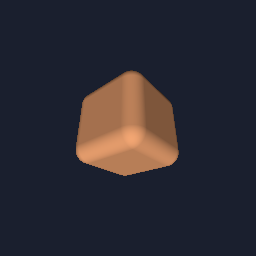
sphere
Section titled “sphere”Signed distance to a sphere of radius r centered at the origin:
length(p) - r.
fn sphere(p: vec3<f32>, r: f32) -> f32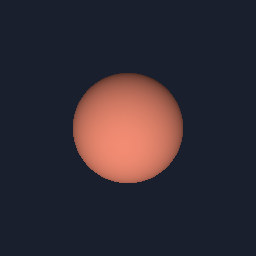
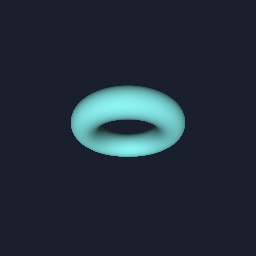
Torus in the XZ plane with major radius t.x and tube (minor) radius
t.y.
fn torus(p: vec3<f32>, t: vec2<f32>) -> f32