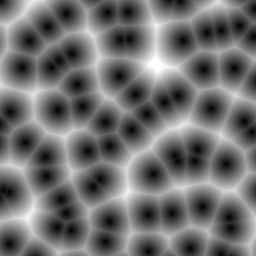

Noise
Procedural noise is the workhorse of generative shading: a deterministic pseudo-random field you can sample anywhere to drive textures, displacement, clouds, terrain, fluid motion, and more. Every entry below is a single pure WGSL function in the registry. Pull one into a composition by slug, then call it from your fragment stage:
let main = r#"@fragment fn fs_main(in: VertexOutput) -> @location(0) vec4<f32> { let n = simplex2(in.uv * 6.0) * 0.5 + 0.5; return vec4<f32>(n, n, n, 1.0);}"#;let shader = Shader::new(&["noise/simplex2", main])?;Each preview below renders the field directly on a UV grid, scaled so the
features are clearly visible. Output ranges vary — value-style functions land
in [0, 1), gradient/simplex variants in roughly [-1, 1], and the multi-
octave family (fbm, ridged, turbulence) sums into wider ranges that you may
want to saturate or remap before shading.
2D curl noise — a divergence-free 2D vector field derived from a scalar potential. Useful for fluid-like motion and particle advection.
fn curl2(p: vec2<f32>) -> vec2<f32>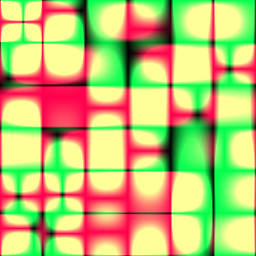
2D fractal Brownian motion: stacked octaves of value noise with halving
amplitude. Output sums to roughly [0, 1] for typical octave counts.
fn fbm2(p: vec2<f32>, octaves: u32) -> f32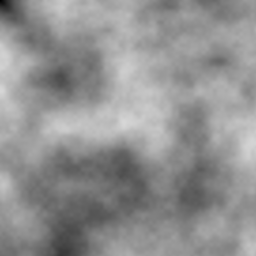
3D fractal Brownian motion. Sample on a fixed slice (e.g. z = 0) for a
2D look, or animate z for a smooth time evolution.
fn fbm3(p: vec3<f32>, octaves: u32) -> f32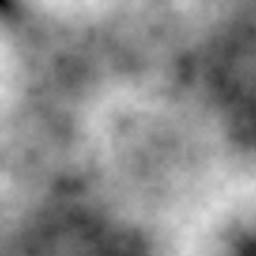
gradient2
Section titled “gradient2”2D gradient (Perlin-style) noise in roughly [-1, 1]. Smooth
derivatives make this a good choice for displacement and bump mapping.
fn gradient2(p: vec2<f32>) -> f32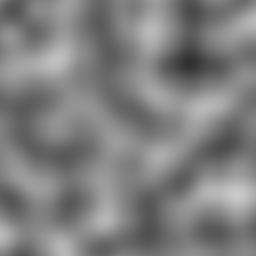
ridged2
Section titled “ridged2”2D ridged multifractal — fbm built from 1 - |noise|. Produces crisp
mountain-ridge patterns; great for terrain and lightning.
fn ridged2(p: vec2<f32>, octaves: u32) -> f32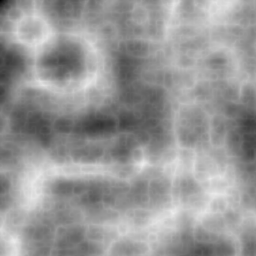
simplex2
Section titled “simplex2”2D simplex noise in roughly [-1, 1] (Ashima-style). Cheaper and less
grid-aligned than gradient noise; the default choice for most shaders.
fn simplex2(p: vec2<f32>) -> f32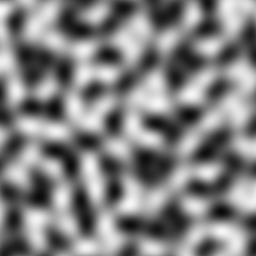
turbulence2
Section titled “turbulence2”2D turbulence: fbm built from |noise|, giving sharper creases than plain
fbm. Classic for flame, smoke, and marble.
fn turbulence2(p: vec2<f32>, octaves: u32) -> f32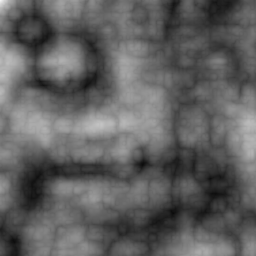
value2
Section titled “value2”2D value noise in [0, 1). Hash-and-interpolate; fastest of the smooth
noises, with visibly grid-aligned features.
fn value2(p: vec2<f32>) -> f32
value3
Section titled “value3”3D value noise in [0, 1). Sample on a slice for a 2D look, or animate
the third axis for time-evolving fields.
fn value3(p: vec3<f32>) -> f32
worley2
Section titled “worley2”2D Worley (cellular) noise. Returns the distances (F1, F2) to the
nearest and second-nearest feature points — common patterns are F1 for
cells, F2 - F1 for edges.
fn worley2(p: vec2<f32>) -> vec2<f32>