Raymarching
Raymarching renders a signed-distance scene by stepping a ray forward by the current SDF distance until it lands on the surface. Once the ray hits, you usually want a surface normal so you can shade the result — and the cheapest way to get one is to sample the SDF a few times around the hit point and read the gradient out of those samples.
This category collects pure normal-from-SDF helpers. The caller owns
the raymarching loop and the scene definition; each helper just turns
a small bundle of distance samples into a unit normal. Pull a helper
into a composition by slug, define your scene(p) SDF, and call the
helper after the trace lands:
let main = r#"fn scene(p: vec3<f32>) -> f32 { return sphere(p, 0.7); }
@fragment fn fs_main(in: VertexOutput) -> @location(0) vec4<f32> {    // ... sphere-trace inline, then:    let e = 0.001;    let k1 = scene(p + e * vec3<f32>( 1.0, -1.0, -1.0));    let k2 = scene(p + e * vec3<f32>(-1.0, -1.0,  1.0));    let k3 = scene(p + e * vec3<f32>(-1.0,  1.0, -1.0));    let k4 = scene(p + e * vec3<f32>( 1.0,  1.0,  1.0));    let n  = normal_from_sdf_tetra(k1, k2, k3, k4);    // ... shade with n}"#;let shader = Shader::new(&["raymarch/normal_from_sdf_tetra", "sdf/sphere", main])?;
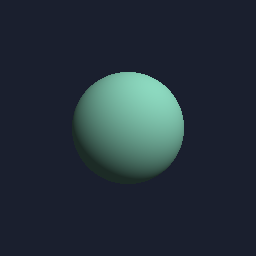
Each preview below sphere-traces a single sphere of radius 0.7, computes the normal with the helper, and shades it with simple Lambert against a fixed light direction.
normal_from_sdf_taps
Section titled “normal_from_sdf_taps”Estimates a surface normal from six central-difference SDF taps
(±x, ±y, ±z). Most accurate of the two, at the cost of six
scene evaluations per pixel.
fn normal_from_sdf_taps(d_px: f32, d_nx: f32, d_py: f32, d_ny: f32, d_pz: f32, d_nz: f32) -> vec3<f32>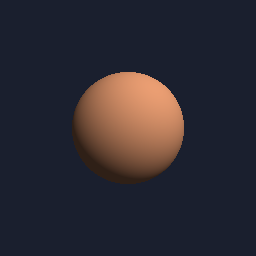
normal_from_sdf_tetra
Section titled “normal_from_sdf_tetra”Cheaper four-tap tetrahedral normal. Pass the SDF values at the four
tetrahedral offsets (+1,-1,-1), (-1,-1,+1), (-1,+1,-1),
(+1,+1,+1); the helper combines them into a unit normal.
fn normal_from_sdf_tetra(k1: f32, k2: f32, k3: f32, k4: f32) -> vec3<f32>