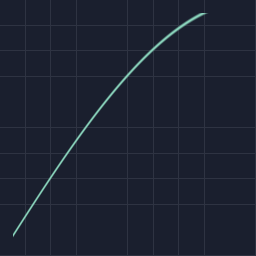

Easing
An easing function maps a normalised time t in [0, 1] to an
eased output, also typically in [0, 1], that you use to animate
properties non-linearly. The standard naming convention from Robert
Penner’s classic library is preserved here: in_* curves accelerate
from rest, out_* curves decelerate to rest, and in_out_* curves do
both — easing in for the first half of the duration and easing out
for the second.
Every entry below is a single pure WGSL function in the registry. Pull one into a composition by slug, then call it from any stage:
let main = r#"@fragment fn fs_main(in: VertexOutput) -> @location(0) vec4<f32> { let t = in.uv.x; let y = out_cubic(t); return vec4<f32>(vec3<f32>(y), 1.0);}"#;let shader = Shader::new(&["easing/out_cubic", main])?;Each preview below plots y = ease(uv.x) as a soft accent line over a
dark grid; warm tones mark in_*, cool tones mark out_*, and neutral
tones mark in_out_*. The vertical axis is y = 0 at the bottom and
y = 1 at the top; curves that overshoot or undershoot (in_back,
out_back, out_elastic) leave the unit box deliberately.
in_back
Section titled “in_back”Cubic curve with overshoot before the start, using the classic Robert Penner constants.
fn in_back(t: f32) -> f32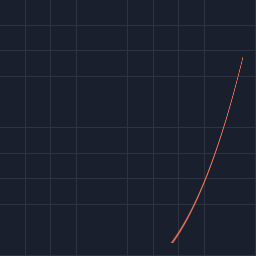
in_cubic
Section titled “in_cubic”t^3 — slow start, steep finish.
fn in_cubic(t: f32) -> f32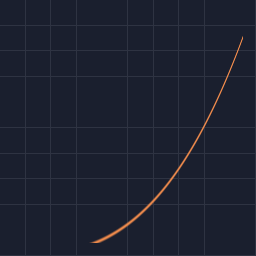
in_expo
Section titled “in_expo”2^(10*(t - 1)) with an exact 0 at t = 0.
fn in_expo(t: f32) -> f32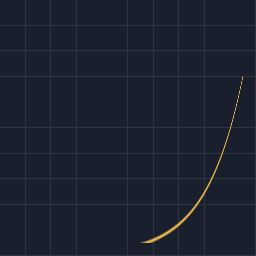
in_out_cubic
Section titled “in_out_cubic”Cubic curve mirrored about t = 0.5: 4 t^3 for t < 0.5, the matching
reflection for t >= 0.5.
fn in_out_cubic(t: f32) -> f32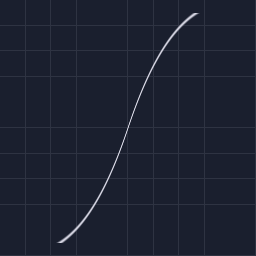
in_out_expo
Section titled “in_out_expo”Symmetric exponential ease that snaps to exact 0 and 1 at the
endpoints to avoid the residual offset of pure 2^x.
fn in_out_expo(t: f32) -> f32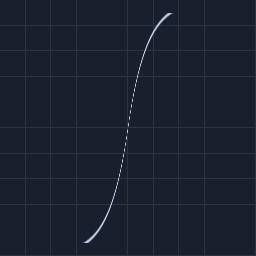
in_out_quad
Section titled “in_out_quad”Quadratic curve mirrored about t = 0.5: 2 t^2 for t < 0.5, the
matching reflection for t >= 0.5.
fn in_out_quad(t: f32) -> f32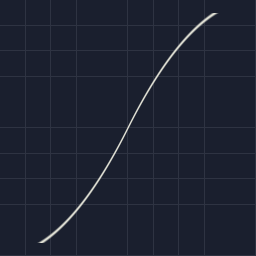
in_out_quart
Section titled “in_out_quart”Quartic curve mirrored about t = 0.5: sharper S-shape than
in_out_cubic.
fn in_out_quart(t: f32) -> f32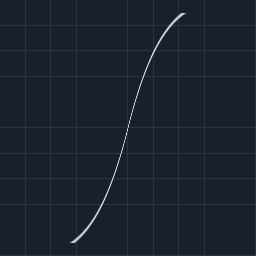
in_out_sine
Section titled “in_out_sine”-(cos(pi t) - 1) / 2 — the smoothest of the standard S-curves.
fn in_out_sine(t: f32) -> f32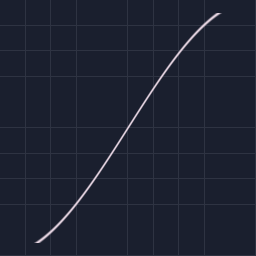
in_quad
Section titled “in_quad”t^2 — gentle slow start.
fn in_quad(t: f32) -> f32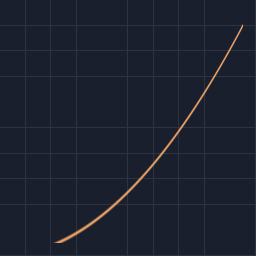
in_quart
Section titled “in_quart”t^4 — much slower start than in_quad, holds near zero longer.
fn in_quart(t: f32) -> f32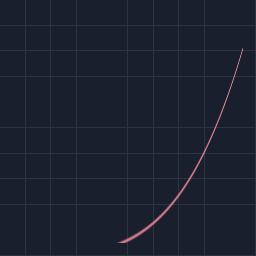
in_sine
Section titled “in_sine”1 - cos(t * pi/2) — quarter-sine ramp in.
fn in_sine(t: f32) -> f32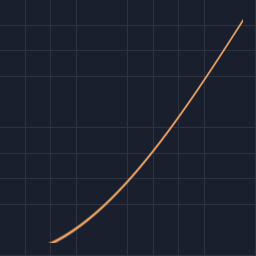
linear
Section titled “linear”Identity curve. The reference baseline for every other entry on this page.
fn linear(t: f32) -> f32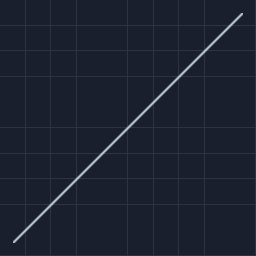
out_back
Section titled “out_back”Overshoots past 1 near the end, then settles. Classic Robert Penner
constants.
fn out_back(t: f32) -> f32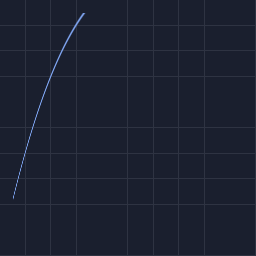
out_bounce
Section titled “out_bounce”Three-step Penner bounce-out: the value lands on 1 after three
diminishing rebounds.
fn out_bounce(t: f32) -> f32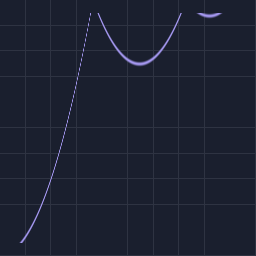
out_cubic
Section titled “out_cubic”1 - (1 - t)^3 — fast start, smooth landing.
fn out_cubic(t: f32) -> f32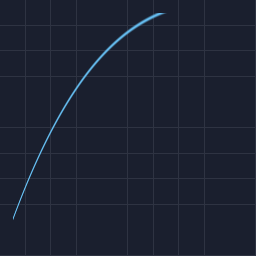
out_elastic
Section titled “out_elastic”Damped sinusoidal oscillation that settles to 1. The curve briefly
exceeds 1 and dips below it before damping out.
fn out_elastic(t: f32) -> f32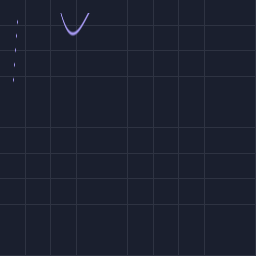
out_expo
Section titled “out_expo”1 - 2^(-10 t) with an exact 1 at t = 1.
fn out_expo(t: f32) -> f32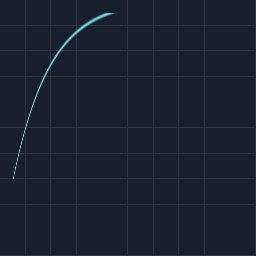
out_quad
Section titled “out_quad”1 - (1 - t)^2 — gentle landing.
fn out_quad(t: f32) -> f32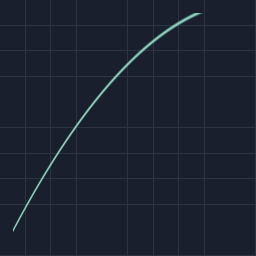
out_quart
Section titled “out_quart”1 - (1 - t)^4 — sharper deceleration than out_quad, very gentle
final approach.
fn out_quart(t: f32) -> f32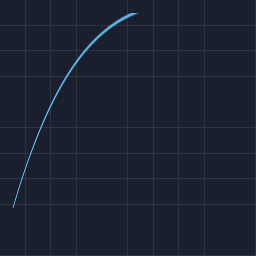
out_sine
Section titled “out_sine”sin(t * pi/2) — quarter-sine ramp out.
fn out_sine(t: f32) -> f32