

Camera
The camera category collects the matrix-builders and ray helpers you reach for when wiring 3D math into a shader: view and projection matrices, the four basic affine transforms, and the two unprojection helpers that turn a screen pixel into either a world-space ray or a world-space point. Each helper is a single pure WGSL function — no uniforms, no globals, no side effects — so you can compose them by slug and call them inline.
The previews below stage a small fixed scene (a raymarched cube, a
ground plane, or a ray-direction visualization) and apply the helper to
it. In your own shader you would chain these with the rest of your
pipeline: proj * view * model * vec4<f32>(p, 1.0) is the canonical
form, where proj comes from perspective or orthographic, view
comes from look_at, and model is some product of translate,
rotate_*, and scale.
let main = r#"@fragment fn fs_main(in: VertexOutput) -> @location(0) vec4<f32> { let view = look_at(vec3<f32>(2.0, 1.5, 3.0), vec3<f32>(0.0), vec3<f32>(0.0, 1.0, 0.0)); let proj = perspective(1.0, 1.0, 0.1, 100.0); let mvp = proj * view; // ... use mvp to project geometry ... return vec4<f32>(0.0);}"#;let shader = Shader::new(&["camera/look_at", "camera/perspective", main])?;look_at
Section titled “look_at”Right-handed look-at view matrix (world to view) given an eye position, a target point, and an up vector.
fn look_at(eye: vec3<f32>, target: vec3<f32>, up: vec3<f32>) -> mat4x4<f32>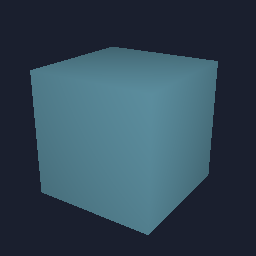
orthographic
Section titled “orthographic”Right-handed orthographic projection from a view-space box defined by
the planes l, r, b, t, near, far into clip space.
fn orthographic(l: f32, r: f32, b: f32, t: f32, near: f32, far: f32) -> mat4x4<f32>
perspective
Section titled “perspective”Right-handed perspective projection mapping view space to clip space.
fov_y is the vertical field of view in radians, aspect is
width / height.
fn perspective(fov_y: f32, aspect: f32, near: f32, far: f32) -> mat4x4<f32>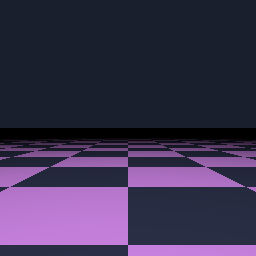
ray_from_uv
Section titled “ray_from_uv”Builds a world-space ray direction from a screen UV. view is the
world-to-view 3x3 basis (rows: right, up, forward looking at -z). Useful
for raymarching directly from a fullscreen triangle.
fn ray_from_uv(uv: vec2<f32>, aspect: f32, fov_y: f32, view: mat3x3<f32>) -> vec3<f32>
rotate_axis
Section titled “rotate_axis”Rodrigues 4x4 rotation around an arbitrary unit axis by a radians.
Pass a normalized axis; results are undefined otherwise.
fn rotate_axis(axis: vec3<f32>, a: f32) -> mat4x4<f32>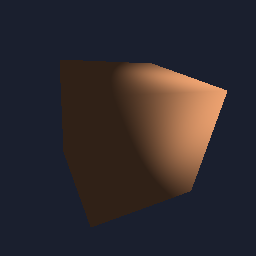
rotate_x
Section titled “rotate_x”4x4 rotation around the X axis by a radians.
fn rotate_x(a: f32) -> mat4x4<f32>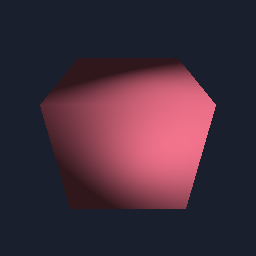
rotate_y
Section titled “rotate_y”4x4 rotation around the Y axis by a radians.
fn rotate_y(a: f32) -> mat4x4<f32>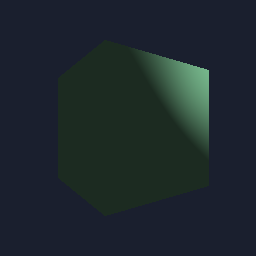
rotate_z
Section titled “rotate_z”4x4 rotation around the Z axis by a radians.
fn rotate_z(a: f32) -> mat4x4<f32>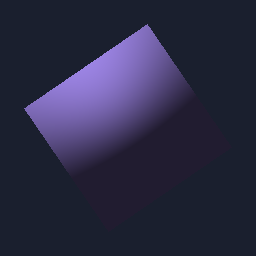
4x4 non-uniform scale matrix. Pass vec3<f32>(s) for uniform scale.
fn scale(s: vec3<f32>) -> mat4x4<f32>
screen_to_world
Section titled “screen_to_world”Unprojects a UV plus a depth value through the inverse of a view-projection
matrix back into world coordinates. The depth is in clip-space z units
(typically 0 for the near plane, 1 for the far plane in the convention
your matrix produces).
fn screen_to_world(uv: vec2<f32>, depth: f32, view_proj_inv: mat4x4<f32>) -> vec3<f32>
translate
Section titled “translate”4x4 translation matrix.
fn translate(t: vec3<f32>) -> mat4x4<f32>