
Math
The math/ slugs are tiny, allocation-free helpers you reach for when
writing every other category in this catalog: linear remaps,
anti-aliased steps, soft pulses, and a few coordinate-space utilities.
Each one is a single pure WGSL function. Pull a slug into a composition,
then call it from your fragment stage:
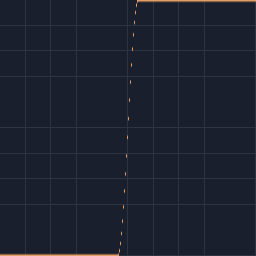
let main = r#"@fragment fn fs_main(in: VertexOutput) -> @location(0) vec4<f32> { let y = smootherstep(0.0, 1.0, in.uv.x); return vec4<f32>(vec3<f32>(y), 1.0);}"#;let shader = Shader::new(&["math/smootherstep", main])?;Scalar 1D helpers are previewed below as a y = fn(uv.x) plot on a dark
grid — read the curve from left to right, with uv.x along the bottom.
2D helpers (checker, grid, NDC remap) are rendered as a field across UV
space.
checker
Section titled “checker”Classic 0/1 checkerboard with cells cells per UV unit.
fn checker(uv: vec2<f32>, cells: f32) -> f32
grid_aa
Section titled “grid_aa”Anti-aliased grid lines: returns 1.0 near a grid line and 0.0
between. period is the spacing in UV units; line_width is the
half-thickness in the same units.
fn grid_aa(uv: vec2<f32>, period: f32, line_width: f32) -> f32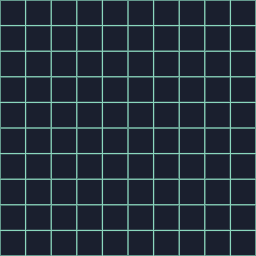
line_aa
Section titled “line_aa”Anti-aliased 1D line at coordinate pos with half-width w. Returns
1.0 on the line and 0.0 far away, with a smooth ramp inside w.
fn line_aa(pos: f32, x: f32, w: f32) -> f32
ndc_to_uv
Section titled “ndc_to_uv”Normalised-device coordinates (-1..1, y up) to UVs (0..1, y down).
fn ndc_to_uv(ndc: vec2<f32>) -> vec2<f32>
Hard rectangular pulse: 1.0 inside [a, b], 0.0 outside.
fn pulse(a: f32, b: f32, x: f32) -> f32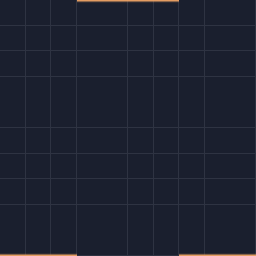
Linear remap from [in_min, in_max] to [out_min, out_max]. The
function does not clamp — values outside the input range extrapolate
linearly past the output range.
fn remap(x: f32, in_min: f32, in_max: f32, out_min: f32, out_max: f32) -> f32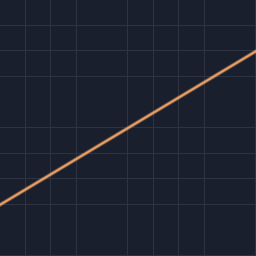
remap_clamped
Section titled “remap_clamped”Same as remap, but the output is clamped to [out_min, out_max] —
the curve is flat outside the input window.
fn remap_clamped(x: f32, in_min: f32, in_max: f32, out_min: f32, out_max: f32) -> f32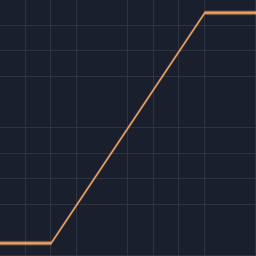
Reciprocal square root with a tiny guard so zero inputs don’t return
Inf.
fn rsqrt(x: f32) -> f32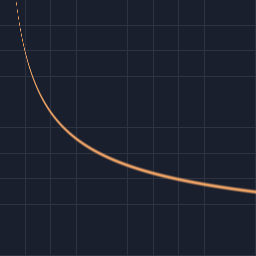
saturate
Section titled “saturate”Clamps a value to the unit interval [0, 1].
fn saturate(x: f32) -> f32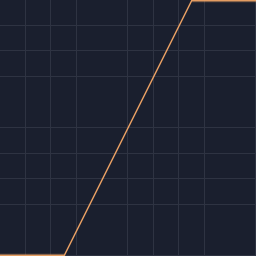
smooth_pulse
Section titled “smooth_pulse”Soft pulse with smoothstep ramps of width w on each edge: gradually
rises into the band [a, b] and falls back out.
fn smooth_pulse(a: f32, b: f32, w: f32, x: f32) -> f32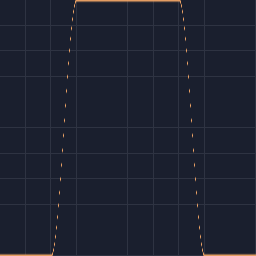
smootherstep
Section titled “smootherstep”Ken Perlin’s second-order smoothstep: 6t^5 - 15t^4 + 10t^3. Same
endpoints and [0, 1] range as smoothstep, but with zero first and
second derivatives at both ends — useful when you want C2 continuity
along an animation curve.
fn smootherstep(edge0: f32, edge1: f32, x: f32) -> f32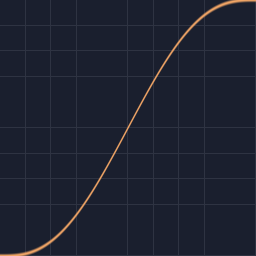
step_aa
Section titled “step_aa”Screen-space anti-aliased step. w is the pixel-space spread of x
(typically length(vec2(dpdx(x), dpdy(x))) or a similar fwidth
proxy); the function smooths the edge across that width.
fn step_aa(edge: f32, x: f32, w: f32) -> f32